
At UOK, we see every day how powerful connection can be. On Social Prescribing Day we want to celebrate the warmth that comes with connection. Read the wonderful Rosie’s full story and learn more about the impact of social prescribing.
Today, on Social Prescribing Day, it feels especially meaningful to reflect on my experience of working as a Social Prescriber within an NHS-linked service ‘Screen and Intervene’. In this role, I have supported people living with severe mental illness, including schizophrenia, bipolar disorder, and psychosis, to work towards more meaningful, connected, and fulfilling lives through the promotion of health and wellbeing.
This work has deeply moved me, challenged me, and humbled me. It has also strengthened my belief that health and wellbeing are not luxuries — they are essential foundations for recovery, dignity, and hope.
Recognition for the work
It feels right to begin by sharing some of the positive recognition our team has received from commissioners. Our service has been acknowledged for its adaptability, proactive approach, and commitment to promoting physical health checks and improving physical health outcomes for clients with severe mental illness.
That recognition means a great deal, because it reflects the heart of what social prescribing is about: meeting people where they are, responding flexibly to their needs, and helping connect them to the support that can genuinely improve their lives.
What is social prescribing?
At its core, social prescribing is about supporting people to improve their wellbeing by connecting them with non-clinical sources of support in the community. It often involves using coaching skills, active listening, and person-centred conversations to help people identify what matters most to them and what they would like to improve in their lives.
For one person, that might mean wanting to meet more people and feel less isolated. For another, it might mean building confidence, getting physically active, finding a sense of routine, or reconnecting with creativity and purpose.
Sometimes the next step is something simple, such as being signposted to a local knitting group, walking group, gardening project, café space, or exercise class. Sometimes it is about helping a person take their first small step towards something they have wanted for a long time but did not feel able to do alone.
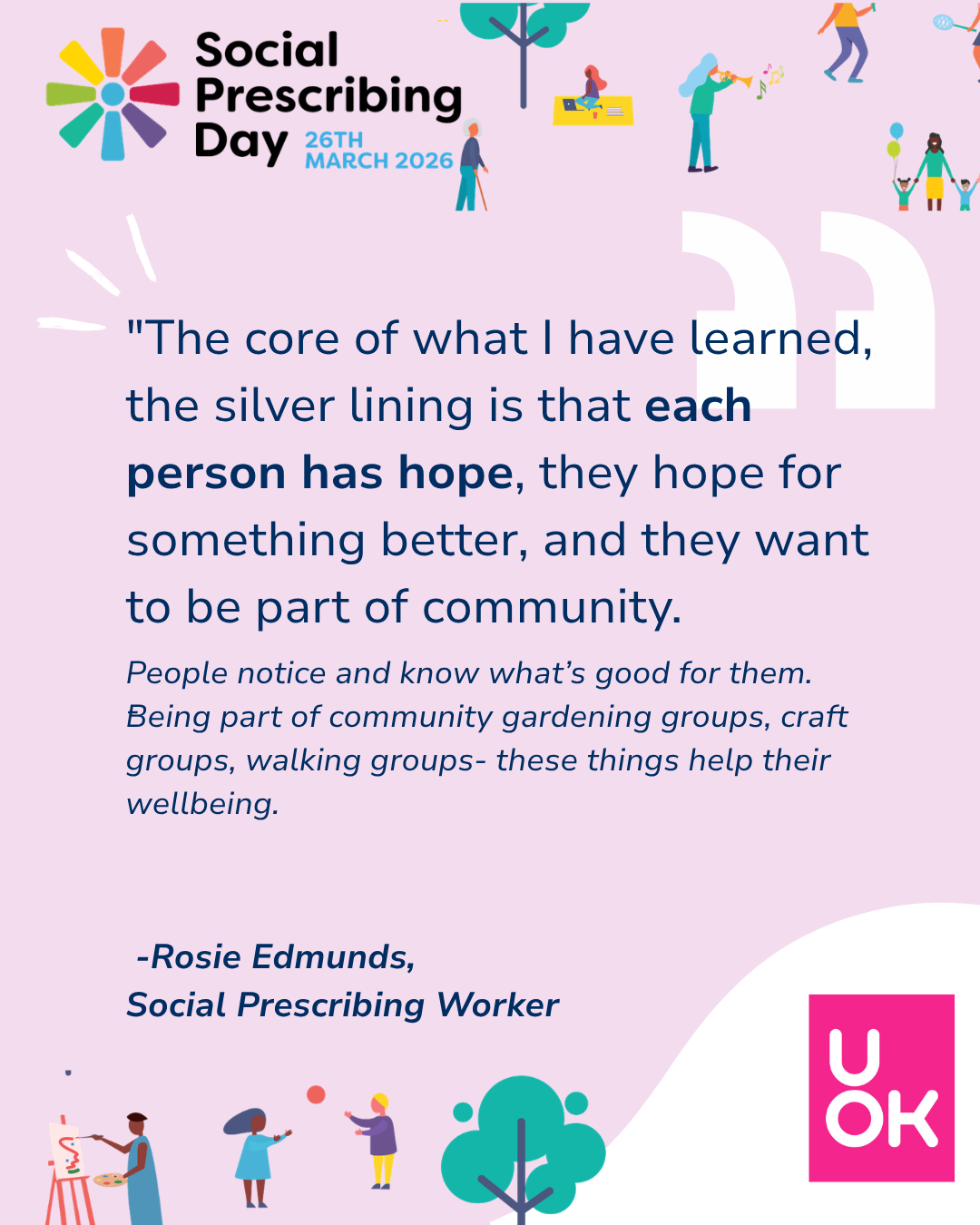
The role of the social prescriber is not to tell people what they need, but to gently guide them towards a renewed sense of purpose, meaning and hope.
I have seen people gain confidence, meaning, and joy simply through accessing free community groups and spaces. That has continually reminded me of how important community, belonging, and human connection are to our wellbeing.
Working with people with severe mental illness
Our service supported clients living with severe mental illness. As a close-knit team, we offered face-to-face sessions in cafés, GP surgeries, and Southdown wellbeing hubs, supporting people by connecting them with services, groups, and community opportunities that could improve their wellbeing.
The work was strengthened by supervision, reflective practice, and ongoing learning. These spaces were essential. They allowed us to think carefully about our caseloads, process the emotional weight of the work, and continue developing as practitioners. In this kind of role, reflection is not an optional extra — it is part of what enables us to support people well.
More than activities: supporting basic needs
Although social prescribing is often associated with wellbeing activities and community groups, much of the work goes far deeper than this. In many cases, it is not only about helping people access a walking group or a creative session. It is also about helping people meet their most basic needs: safe housing, food, financial stability, and security.
It is deeply sad, but not surprising, that many people living with severe mental illness also face unstable housing, poverty, trauma, and social exclusion. A large part of my work has involved signposting people to housing support and learning about the services available to help clients access more secure accommodation. These realities cannot be separated from conversations about health and wellbeing. To talk about recovery without acknowledging housing insecurity, hunger, or fear would be to miss the full picture of people’s lives.
The people I will not forget
What has stayed with me most are the people.
The client who struggles to walk because they had polio as a child.
The woman living with unstable housing, who had to fight to live away from an abuser.
The woman experiencing profound loneliness.
The man who has never really had the space to speak about his emotions because of cultural expectations.
The people who fear services because of past experiences of prejudice and racism.
The people who have been in the care system and lived through abuse and neglect.
The man estranged from his children, living in his car, who still said, “Some people have it worse.”
I will not forget these people.
Each person carried a story. A story of pain, but also of resilience. A story of surviving things that would have broken many people. A story, often, of still hoping for something better.
That is one of the most powerful things I have learned in this role: even when people have experienced enormous hardship, many still long for community, purpose, creativity, and connection. They know, sometimes instinctively, that belonging matters. They know that gardening groups, craft groups, walking groups, exercise classes, volunteering, or work can help restore something important within them.
This has moved me deeply. It has made me reflect on how fundamental belonging is to us as human beings. To be seen, supported, cared for, and part of something larger than ourselves is not a small thing. It is one of our deepest needs.
What this work has taught me
This work has humbled me. It has reminded me that there are people in our own communities living without stable housing, struggling to access food, living in fear, or carrying invisible trauma. It has made me value what I have more deeply and recognise how much simple acts of kindness matter.
This work has also strengthened my belief that health and wellbeing support is preventative. It can help reduce the burden of worsening mental ill health, support recovery alongside medication and clinical care, and help GPs and healthcare services by addressing some of the wider factors affecting people’s lives.
As Frome model of Primary Care (2017) indicates social prescribing can lead to 94% of clients feeling more able to manage their health and wellbeing, 96% of people feeling more able to access community support, and a 21% reduction in healthcare costs.
This highlights what I believe, that wellbeing matters, that prevention matters, and that investing in people’s lives has a positive impact not only on individuals, but also on communities and the wider economy.
I have also learned the importance of both cognitive and emotional empathy: not only trying to understand what someone may be going through, but responding in a way that helps them feel seen, respected, and valued.
Gratitude for my team
I am incredibly grateful to my team, because without them this work would not have been possible in the way it has been. We worked closely, supported one another, and benefited from supervision and reflective practice that strengthened how we worked and how we cared for the people we supported.
In roles like this, teamwork matters enormously. So much of the work depends on being able to share challenges, think together, and hold the emotional weight of the role collectively rather than alone.
A final reflection
One of the most important lessons I take from this work is that it really can happen to anyone. Mental ill health, poverty, homelessness, abuse, loneliness, and exclusion are not things that happen only to “other people.” They are part of the reality of life for many, and they call for compassion rather than judgement.
The people I have met are not separate from us. They reflect what all of us need at our core: support, care, safety, belonging, meaning, and hope. That thread runs through every one of us. To everyone working in healthcare, community support, and charities: your work matters. It makes a difference.
And to anyone struggling: you are not alone. Support does exist. There are people, services, and charities doing genuinely life-changing work every day. It may not always be enough, and there is always more that is needed, but there is kindness, help, and hope out there.
I will not forget a single client I have worked with in person. Each one has stayed with me. Each one brought strength, bravery, and humanity into the room. Each one, in their own way, was trying to make something beautiful from what life had handed them.
That is something I will carry with me.